The Complete Roof Insurance Claim Guide for Eastern Shore Homeowners
If a storm just rolled through Salisbury, Ocean Pines, Berlin, or anywhere else on the Delmarva coast and your roof took damage, the next 30 days matter more than you think. Filing a roof insurance claim the right way can mean the difference between a fully covered replacement and a denied claim that leaves you paying out of pocket.
We have worked with almost every major insurance carrier on the Eastern Shore over the last two decades, and we have seen the same claim mistakes repeat over and over. This guide walks you through the entire process, start to finish, so you know exactly what to do, when to do it, and what to watch out for.
When should you file a roof insurance claim?
The short answer: as soon as you suspect damage, and always after a named storm.
The common mistake is waiting. Homeowners often think, “The roof seems okay from the ground, I will deal with it later.” By the time a small wind-lifted shingle becomes a visible leak in the ceiling, you may be months past the carrier’s reporting window.
File a claim when any of these are true:
- A named storm (nor’easter, tropical storm, hurricane) passed through your area, even if you do not see obvious damage
- You see missing, lifted, or curled shingles
- You find shingle granules in your gutters or downspouts after a storm
- You see dents in metal flashing, vents, or gutters (hail damage indicator)
- A tree limb or other debris hit your roof
- You see water staining on ceilings or interior walls
- Your attic shows light coming through or water signs after rain
Most Maryland and Delaware homeowners policies require you to report damage within 365 days of the event. Some require 60 to 90 days. Read your specific policy’s “duty after loss” section, or call us and we will help you check.
5 roof insurance claim myths that cost homeowners money
These are the mistakes we see most often on the Eastern Shore. Every one of them has cost someone a legitimate claim.
Myth 1: “If I file a claim, my premium will go up”
Not for storm damage claims. Storm damage is considered an “act of God” and is not rated against your personal claim history the way an at-fault auto accident is. Your premium may go up eventually, but that is usually because your carrier is adjusting rates regionally after a bad storm season, not because of your specific claim.
Myth 2: “I need 3 contractor estimates first”
You do not. Your insurance company does not require multiple estimates. Your adjuster will inspect the damage and write their own scope. Getting 3 estimates slows down the process and lets the carrier anchor on the lowest number.
What you actually need: one qualified roofing contractor who will meet with the adjuster at your roof. That is where the real negotiation happens.
Myth 3: “My adjuster and my roofer will figure it out”
Many adjusters are contractors who travel in from out of state after storms. They are paid by volume and under pressure to close claims fast. Without your roofer present at the inspection, you are relying entirely on the adjuster’s judgment about what needs repair and what does not.
Always schedule your adjuster meeting at a time your roofer can be on the roof with them.
Myth 4: “A cosmetic dent is not a real claim”
Depends on the policy. Many carriers now exclude “cosmetic damage” specifically for Class 3 shingles. However, if hail impact has broken the shingle’s seal or water barrier, that is functional damage and should be covered. A qualified roofer can document the difference on camera at the adjuster meeting.
Myth 5: “I can just take the cash and live with the old roof”
In most states, this was once possible. In Maryland and Delaware as of 2025, carriers are tightening this up. If you take the Actual Cash Value (ACV) payout and do not actually complete the repair, you may forfeit the Replacement Cost Value (RCV) portion, and your carrier can non-renew your policy for failure to maintain the property.
The claim process, step by step
Here is the exact sequence of events from storm to new roof.
Step 1: Document the damage immediately (day of storm)
- Take photos from the ground of every side of your house
- If you can safely reach the attic, photograph any water signs or daylight visible through the roof deck
- Save any debris (hail stones, tree limbs on the roof) if you can photograph them in place
- Note the date, time, and weather conditions
Do not climb on the roof. Leave that to the professionals.
Step 2: Call a qualified roofer first (day 1 to 3)
Before you even call the insurance company, call a licensed local roofer and ask for a free inspection. This serves two purposes: you find out if there is actual damage, and you get a roofing partner lined up for the adjuster meeting.
If our team inspects your roof and finds no damage, we tell you directly and you do not file a claim. There is no reason to burn a claim on a phantom issue. If we find damage, we document it and help you plan the call to your carrier.
Step 3: File the claim (day 2 to 7)
Call your insurance company’s claims line. You will be asked:
- Your policy number
- The date and type of loss (for example, “April 15, 2026, wind damage from nor’easter”)
- A description of the damage
- Whether any interior damage exists
- Whether you need emergency tarp service
Request a claim number and your adjuster’s name and contact info. Do not agree to any specific scope over the phone. The adjuster has not inspected yet.
Step 4: Schedule the adjuster meeting and invite your roofer (day 7 to 14)
When the adjuster calls to schedule, make sure to:
- Pick a time when your roofer can be there on the roof with the adjuster
- Confirm the time with your roofer first, then call the adjuster back
- Do not meet the adjuster alone on a damaged roof
At G and Bros, we treat the adjuster meeting as a standing appointment for any claim we are handling. We climb with the adjuster, walk the damage, and document what we see on camera.
Step 5: Review the scope and supplement if needed (day 14 to 30)
After the meeting, the adjuster sends you a scope of work and a payment breakdown. This will include:
- ACV payment: Actual Cash Value, the depreciated value of your old roof. Sent first.
- Depreciation: The difference between ACV and RCV, held back until repairs are complete.
- RCV recovery: Released after you complete the work and submit the final invoice.
- Deductible: Your out-of-pocket portion. Deducted from the final payout, not from the ACV.
If the scope is missing items (like upgraded code-required underlayment, starter strip, ridge vent, or necessary drip edge on a coastal home), your roofer can supplement the claim. This is a formal request to the adjuster to add missing line items. Supplements are normal and expected on about half of roof claims.
Step 6: Sign the contract and schedule the work (day 21 to 45)
Once the scope is agreed, sign a contract with your roofer. The contract should reference the approved insurance scope and note that any adjustments will go back to the carrier as supplements, not to you.
Work typically starts 1 to 3 weeks after contract signing, depending on materials availability and weather.
Step 7: Complete work and collect RCV (day 45 to 60)
After the install, your roofer submits the final invoice and photos to your carrier. The RCV (recoverable depreciation) is released within 1 to 4 weeks. You pay your roofer using the combined ACV, RCV, and (if applicable) your deductible.

Understanding ACV, RCV, deductible, and depreciation
These four terms confuse more homeowners than any others on a claim. Here is what each one means in plain English, using a sample $15,000 claim with a $2,000 deductible.
| Term | Definition | In the example |
|---|---|---|
| RCV (Replacement Cost Value) | What it costs to replace the roof brand new today | $15,000 |
| Depreciation | How much the old roof had lost to age | $4,000 |
| ACV (Actual Cash Value) | RCV minus depreciation, your first check | $11,000 |
| Deductible | Your out-of-pocket portion | $2,000 |
| Carrier’s first payment | ACV minus deductible | $9,000 |
| Carrier’s second payment | Released after repair completion, equals depreciation | $4,000 |
| Total paid by carrier | ACV + depreciation minus deductible | $13,000 |
| Total you owe the roofer | Full project cost | $15,000 |
| Your actual cost | Deductible only | $2,000 |
The big takeaway: your deductible is the only thing you pay out of pocket for a covered claim. The carrier pays the rest, just in two checks instead of one.
Why having a roofer on your side before the adjuster matters
The adjuster is not your enemy, but they do work for the insurance company. Their job is to write the smallest defensible scope. Our job is to write the scope that actually restores your roof to pre-storm condition.
A few real examples from Eastern Shore claims we have handled recently:
- An Ocean City adjuster wrote a “partial slope replacement” scope. We documented that the shingle matching was impossible (the product was discontinued) and supplemented for a full-roof replacement. Approved.
- A Salisbury adjuster missed the ice-and-water shield upgrade required by current Wicomico County code. We supplemented for code upgrade coverage. Approved.
- A Fruitland adjuster denied wind damage on a low-slope section, citing “wear and tear.” We documented the date of the storm, wind speed at the local weather station, and the direction of shingle uplift. Supplement approved on appeal.
Without a roofer present at the meeting, none of these supplements would have happened.
Common storm damage types we see on the Eastern Shore
Different storms cause different patterns of damage. Knowing what to look for helps you file a stronger claim.
Wind damage (nor’easters, tropical storms): Missing shingles, lifted shingles that will not lay flat, shingles on the ground around the house, granule loss in gutters, damaged ridge caps.
Hail damage (spring and summer thunderstorms): Circular dents on shingles, dents on metal vents and flashings, bruised or cracked shingles where granules have been knocked off, damaged gutters and downspouts.
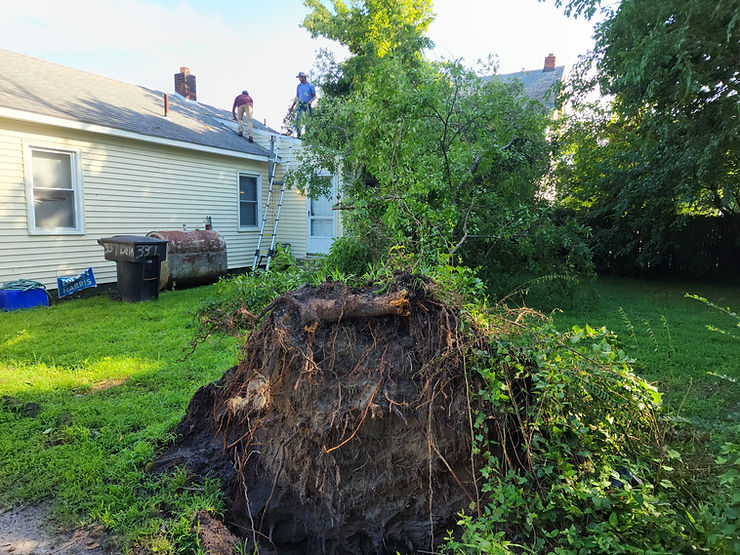
Tree or debris impact: Punctured roof deck, broken trusses, cracked shingles, damaged gutters.
Ice damming (rare on Delmarva but possible after a February nor’easter): Interior ceiling water stains, water at the drip edge, curled shingles at the eaves.
How G and Bros supports the claim from start to finish
Our storm-restoration process is built around the claim, not separate from it. Here is what we actually do:
- Free drone inspection. We fly every slope of your roof and show you the damage on screen the same day.
- Damage documentation package. Photos, descriptions, storm metadata for the claim.
- Adjuster meeting attendance. We climb the roof with the adjuster and advocate for the full scope.
- Supplement negotiation. We handle missing line items directly with the carrier.
- Code-compliant install. Everything installed to current Maryland or Delaware code, with documentation.
- Final invoice and RCV release. We submit the paperwork so your depreciation check gets released quickly.
We do not charge extra for any of this. It is built into how we handle every storm claim.
See our storm restoration services for more, or learn about our full roof replacement process if your claim is approved.
Answers to the questions homeowners ask most
Q: Do I have to use a specific roofer my insurance company recommends? A: No. Maryland and Delaware law allow you to choose any licensed roofer. “Preferred contractor” networks are optional, not required.
Q: Will my claim be denied if the roof is old? A: Age alone does not deny a claim. Wear-and-tear exclusions apply only when the damage is clearly from age rather than the storm. A good roofer can document the distinction.
Q: How long do I have to file? A: Check your policy’s “duty after loss” clause. Most Maryland and Delaware policies allow 365 days, but some require 60 to 90 days. File early if you can.
Q: What if my claim is denied? A: You can request an appeal with additional documentation. If that fails, the Maryland Insurance Administration and Delaware Department of Insurance both have consumer complaint processes. A qualified roofer can help you build the appeal file.
Q: Do I really need to pay my deductible? A: Yes. Maryland law (Insurance Code § 27-216) and Delaware law both specifically prohibit roofers from waiving or rebating deductibles. Any roofer who offers to “eat the deductible” is breaking state law and putting your claim at risk.
Get a free damage inspection after any major storm
The first step on every claim is knowing whether damage actually exists. We offer free drone inspections for any Eastern Shore homeowner after a storm, with no obligation. If we find damage, we help you file the claim the right way. If we do not find damage, we tell you and you save the claim for when you actually need it.
Need a roof inspection after a storm? Contact G and Bros today. Call (410) 677-4975 or request a free inspection online.

Recent Blog Posts