PRO: Building a Roofing Production Schedule That Survives Storm Season
Why Production Schedules Fall Apart When You Need Them Most
The schedule that works in May looks completely different from the one that has to survive a summer hail event or a September tropical system. A production schedule built for the good weeks fails when it counts. This post is for roofing contractors: here is how we think about building one that holds up, from our shop in Salisbury, MD.
The Two Ways a Schedule Breaks
Most production schedules fail in one of two patterns. The first is the slow creep: each job slides a day, then two, then a week, until you are calling customers to apologize and crews are losing time in the gaps between jobs. The second is the storm drop: a hail event or tropical system floods you with leads in a few days, and the calendar you had stops mattering because everything shifts to triage.
Both share the same root cause. The schedule was built on assumptions instead of confirmed information. A Tuesday start assumes materials landed Monday, the scope is approved and the crew is not still finishing last week’s job. Pull one of those out and the day collapses.
Four Things to Confirm Before a Job Gets a Date
The fix is a simple gate. A job does not get a confirmed start date until all four of these are confirmed, not assumed.
Signed contract and deposit received. Not a verbal yes. In Maryland, remember the deposit at signing cannot be more than one third of the contract price.
Material delivery confirmed for a specific date. Not “sometime next week.”
Permit pulled or applied for. Know which office issues it: incorporated towns often run their own, separate from the county.
Scope confirmed in writing. A signed scope for retail jobs, and the insurer’s approved scope for insurance jobs.
Jobs missing any of the four sit in a pending stage, not on the calendar. It feels slower. What it really does is stop you from promising a start date you cannot keep.
Handling the Storm Drop
Storm volume is the test your system passes or fails. The companies that respond fastest win the work, but speed without a system turns into overpromising, double-booking and frustrated customers who leave reviews months later.
We run our pipeline in JobNimbus. During a surge, the board shows every lead, estimate and active job in one place, and records move between stages as they progress. That lets the Monday dispatch plan come out of one meeting instead of a spreadsheet three people have been editing from their phones.
Here is our honest take on where a job-board CRM like that fits and where it does not.
For residential replacement work with a handful of crews, job-level visibility is usually what you need. The tool only works if someone owns keeping each stage current.
Build a Float Day Into Every Week
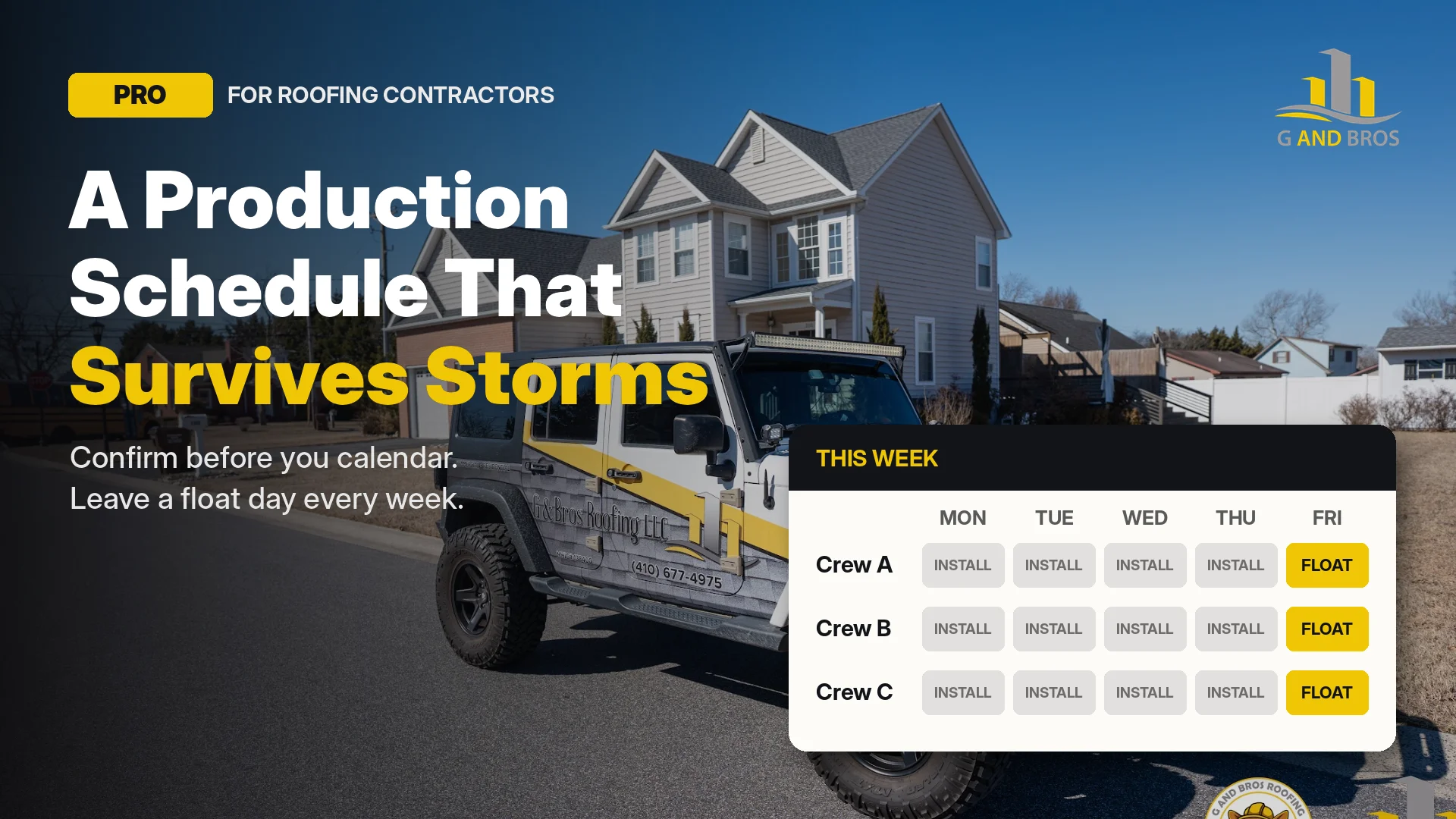
The habit that causes the most pain is filling every slot. A crew booked for five install days has no room for a rained-out morning, a decking problem that doubles a job, or a delivery in the wrong color.
A rule worth adopting: book no more than four install days per crew per week, and treat the fifth as a float. It covers callbacks, warranty service, overruns and inspection follow-ups. If the week stays clean, fill it late in the week from the pending queue. If the week goes sideways, it is the reason you do not have to call a confirmed customer and push them again.
The Weekly Production Meeting
A short Monday meeting with the same checklist every week keeps the system honest:
- Active jobs: status of everything in progress, and anything from last week that needs follow-up
- Materials: confirmed delivery for every job on this week’s calendar
- Permits and inspections: anything waiting on an inspection before it can close out
- Insurance jobs: every open item has an owner and a follow-up date
- Next two weeks: does every scheduled job still pass all four confirmations?
- Float plan: what goes in the float day this week, and who handles it
That last item matters more than it looks. If nobody plans the float day, everyone assumes it is empty, it gets double-filled, and you are back to a fragile week that breaks on the first rainy Tuesday.
What Changes During Storm Season
On the Delmarva Peninsula, tropical systems and strong summer storms can bring a wave of work all at once. The contractors who come out of that stretch ahead are the ones who treated their schedule as a working system before the storm hit.
Two changes help. First, tighten your follow-up window: leads that are actively moving get priority over leads that have gone quiet, so confirmed work does not pile up while you chase cold calls. Second, give insurance jobs their own pipeline track, with stages like adjuster meeting, approved scope and documentation requested, so you can see the insurance backlog separately from retail jobs you can schedule tomorrow.
Maryland contractors, know the line: according to the MHIC, unless you are also licensed as a public adjuster, you may not prepare the homeowner’s insurance claim, negotiate it with the insurer, or advise the homeowner on it. Track the documentation your team provides, not a negotiation you are not allowed to run.
Source: Maryland Home Improvement Commission guidance for licensed contractors.
Frequently Asked Questions
How far out should a roofing company book confirmed jobs?
For most small and midsize residential operations, a few weeks of confirmed starts is plenty. Further out, too much changes: material availability, customer situations and insurance approvals. Keep the confirmed calendar tight and the pending pipeline longer.
How do you handle a rain delay without losing the customer?
Plan for it before it happens. When a job goes on the calendar, know where it moves if it rains. If there is no slot to move it to because the week is full, the rain just exposed a problem that was already there.
How many install days should each crew be booked for?
A good rule is four install days per crew per week with one float day. The float absorbs rain, overruns and callbacks so one bad day does not push every customer behind it.
How should insurance jobs be tracked differently from retail jobs?
Give them their own pipeline stages, such as adjuster meeting, approved scope and documentation requested, and assign an owner and follow-up date to every open item. In Maryland, a contractor who is not a licensed public adjuster may not negotiate the claim, so the stages should track documentation and scheduling, not negotiation.
Which storm leads should you prioritize when volume is high?
Prioritize leads that are actively moving forward: homeowners who respond quickly and book a site visit. Set a firm window for follow-up, and move quiet leads down so confirmed work does not stall.
The Bottom Line
A schedule that survives storm season is not more complicated than one that fails. It is more honest about what is actually confirmed, how much buffer you need, and what happens when volume jumps overnight. Build the system during a quiet week and it will be there when the quiet weeks end.
If you landed here as a homeowner on the Eastern Shore, we are a roofing company too. G and Bros is GAF Certified Plus, family-owned since 2012, with 25+ years of Maryland roofing experience from our founder. Call 410-677-4975 or contact us online.

Recent Blog Posts