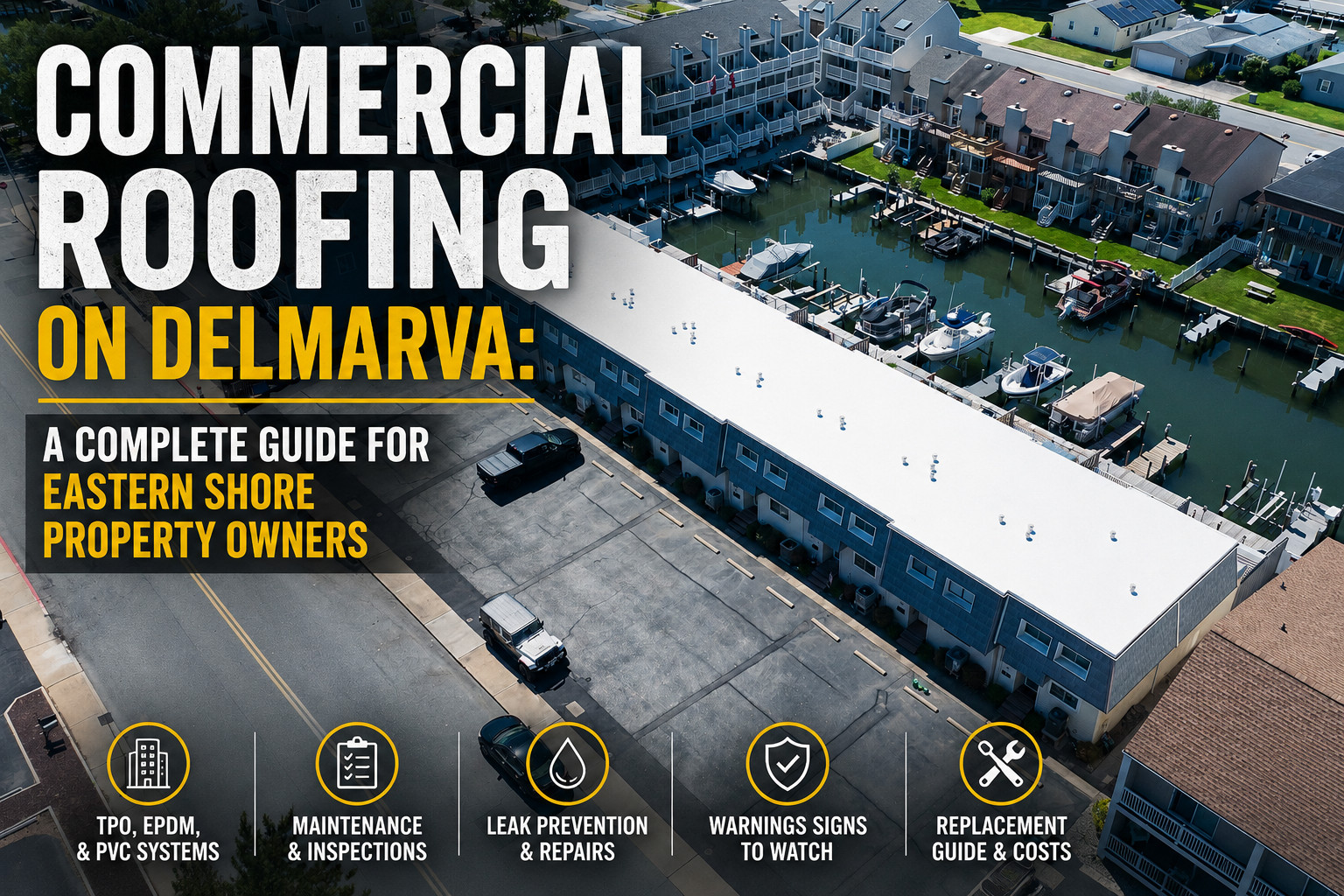
Commercial Roofing on Delmarva: A Complete Guide for Eastern Shore Property Owners
Own a commercial building on Delmarva (Salisbury, Ocean City, anywhere across the Eastern Shore)? Your roof is one of the largest and most expensive assets on the property, and it works differently from a residential roof in ways that catch a lot of property owners off guard.
This guide covers the essentials: what kind of commercial roof you probably have, how the Delmarva coastal climate affects it, what real maintenance looks like, the warning signs you should never ignore, and what to expect when it is time to replace.
Why Delmarva Commercial Roofs Are Different from Residential
Most residential roofs are sloped and shed water by design. Commercial roofs are almost always flat or low-slope, which means water has to be channeled to drains, scuppers, or gutters rather than running off naturally. That basic difference changes everything: the materials, the failure modes, the maintenance routine, and the cost.
On Delmarva specifically, three regional factors hit commercial roofs harder than residential:
- Wind-driven coastal storms. Nor’easters and tropical systems push water sideways into seams, flashing, and drain boots. Flat roofs have hundreds of seams where pitched roofs have continuous slopes.
- Salt air corrosion. Properties within a few miles of the Atlantic or Chesapeake see standard galvanized fasteners and metal flashing corrode faster than inland buildings. Commercial roofs have dramatically more metal components than residential.
- Standing water on flat surfaces. Chesapeake Bay watershed humidity keeps Delmarva roofs damp longer between rain events. On a flat roof, that combines with poor drainage to create ponding zones that destroy membranes faster than anything else.
The 3 Main Commercial Roof Systems
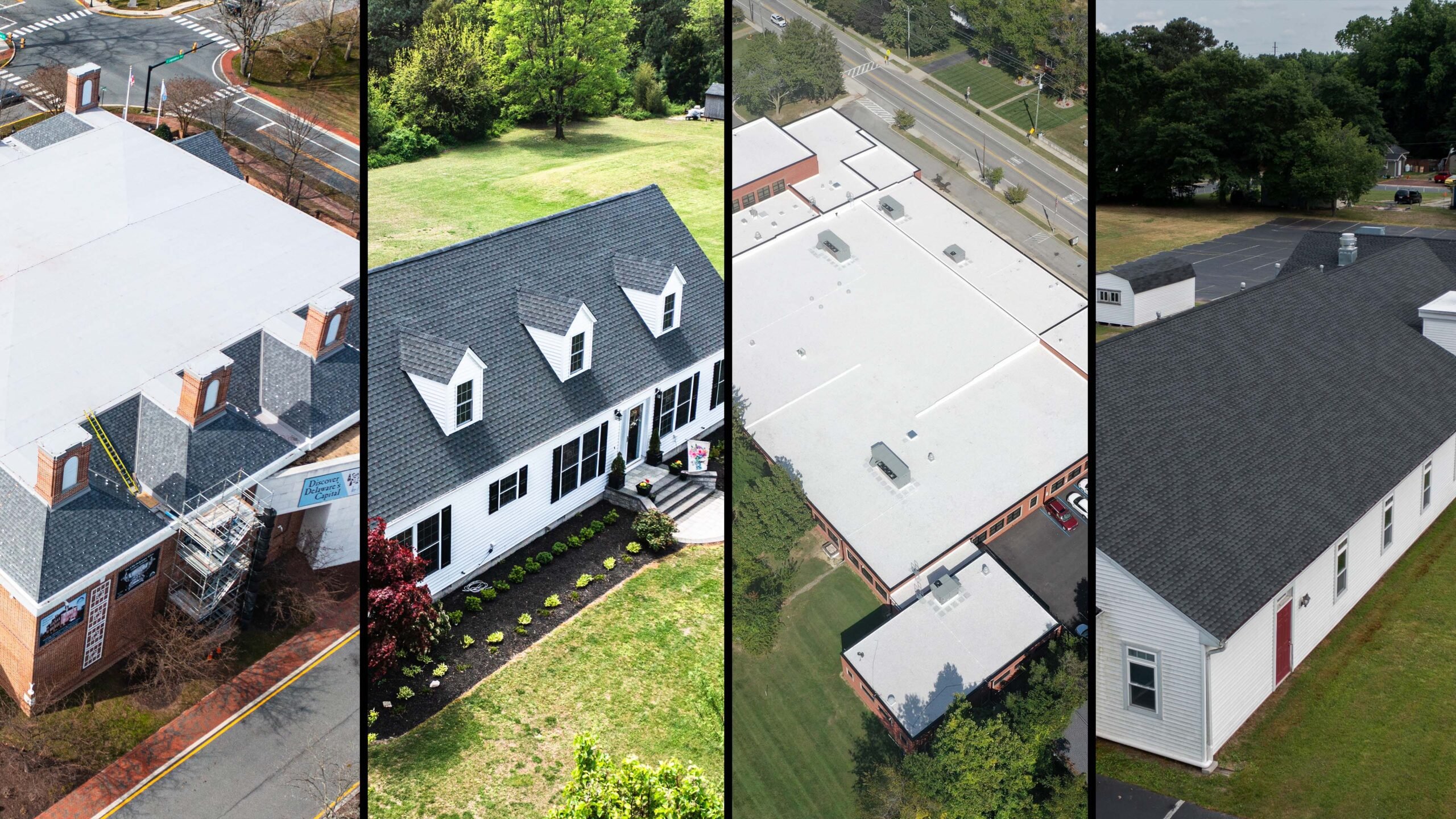
For most Delmarva commercial buildings, you have one of three flat-roof membrane systems:
TPO (Thermoplastic Polyolefin)
The most common new commercial roof installed today. White single-ply membrane that reflects heat (lowering cooling costs in summer), welds at seams via heat (rather than glue), and resists chemical exposure well. Typical lifespan: 20 to 30 years. Strong choice for most Delmarva commercial buildings.
EPDM (Ethylene Propylene Diene Monomer)
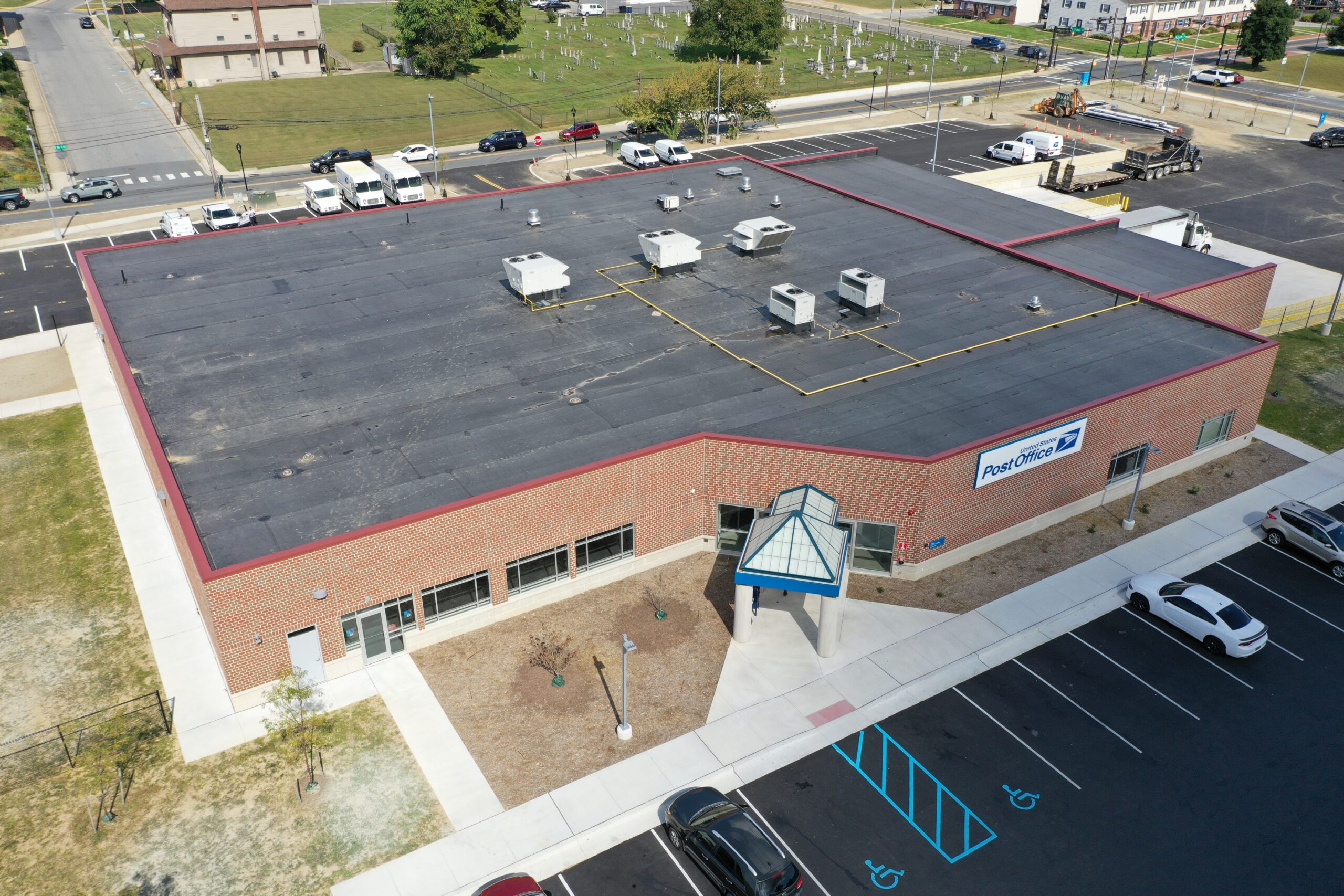
Black rubber membrane, the longest-running commercial roofing material on the market. Extremely durable in cold weather, holds up to UV, and easy to repair. Downside: black surface absorbs heat in summer, raising AC costs on cooled buildings. Typical lifespan: 20 to 30 years.
PVC (Polyvinyl Chloride)
Premium single-ply white membrane similar to TPO but with stronger chemical and fire resistance. Common on restaurants (grease exposure) and industrial buildings. More expensive than TPO upfront but exceptional longevity. Typical lifespan: 25 to 30+ years.
The Three Systems at a Glance
| System | Membrane | Key strengths | Notes | Typical lifespan |
|---|---|---|---|---|
| TPO | White single-ply, heat-welded seams | Reflects heat and lowers summer cooling costs. Resists chemical exposure. | Lower end of the cost range. Strong choice for most Delmarva commercial buildings. | 20 to 30 years |
| EPDM | Black rubber | Extremely durable in cold weather. Holds up to UV. Easy to repair. | Black surface absorbs heat, raising AC costs on cooled buildings. | 20 to 30 years |
| PVC | Premium white single-ply | Stronger chemical and fire resistance. Common on restaurants and industrial buildings. | More expensive upfront. Higher end of the cost range. | 25 to 30+ years |
TPO is highlighted because it is the strongest default for most Delmarva commercial buildings. The right pick still depends on your building use, roof access, and budget.
What Real Commercial Roof Maintenance Looks Like

A commercial roof that gets professional maintenance lasts 30 to 50 percent longer than one that gets ignored. Real maintenance is not just “look at it once a year.” Here is what we actually do on Delmarva commercial maintenance visits:
- Walk the entire roof field, looking for blisters, punctures, seam separation, and membrane shrinkage.
- Inspect every drain, scupper, and gutter for blockages and proper flow.
- Check every flashing detail: parapet walls, HVAC curbs, plumbing vents, expansion joints.
- Look for ponding water (standing more than 48 hours after rain), which destroys membranes faster than any other issue.
- Photo-document everything for the building owner’s records.
- Submit a written report with prioritized repair recommendations.
For most Delmarva commercial properties we recommend twice-yearly professional inspections: once in spring before hurricane season, once in fall after the leaves are down.
Warning Signs Your Commercial Roof Needs Replacement
A commercial roof rarely fails suddenly. It tells you it is failing for years before it finally lets water in. Here are the warning signs we tell every Delmarva property owner to watch for:
- Ponding water 48+ hours after rain. This is the number-one killer of flat roofs.
- Visible seams pulling apart. Especially on EPDM and TPO membranes.
- Bubbles, blisters, or wrinkles across the membrane. Sign of trapped moisture under the surface.
- Repeated interior leaks during nor’easters. If water comes in at the same spot every storm, the system has failed.
- Membrane shrinkage pulling away from flashing. The membrane is at end-of-life.
- Roof is past 20 to 25 years old. Repairs become a way of investing money in a roof near the end of its life.
What to Expect from a Commercial Roof Replacement
A full commercial replacement is a bigger project than a residential one. Expect:
- 1 to 3 weeks of active work depending on building size and complexity.
- Tear-off to deck with thorough deck inspection and replacement of any soft sections.
- New insulation (a chance to upgrade R-value and lower long-term energy costs).
- New membrane system (TPO, EPDM, or PVC depending on building needs).
- All new flashing details at parapets, curbs, and penetrations.
- Phased work around your operations if your building stays open during the project.
Cost varies widely by building size. As a rough rule of thumb for Delmarva commercial properties: expect $8 to $15 per square foot for a quality membrane system, with TPO at the lower end, PVC at the higher end. A 10,000 square foot commercial roof typically runs $80,000 to $150,000 for a full replacement.
Choosing a Delmarva Commercial Roofing Contractor
Commercial roofing requires specific certifications and experience that residential roofers do not always have. Confirm these before hiring:
- Manufacturer certification (Carlisle, Firestone, GAF Commercial, etc.) on whichever membrane is being installed.
- Liability insurance and workers’ comp for commercial-scale work (higher limits than residential).
- A real local presence with verifiable commercial projects nearby on Delmarva.
- Written maintenance and warranty packages available for ongoing service after install.
G and Bros installs and maintains commercial roof systems across Salisbury, Ocean City, and the entire Eastern Shore. We carry full commercial liability coverage, are GAF Certified, and run twice-yearly maintenance programs for property owners who want their roofs to actually last.
Frequently Asked Questions
How long does a commercial roof last on Delmarva?
20 to 30 years for a quality membrane system installed correctly and maintained twice yearly. Closer to 15 years for a system that gets installed cheap or never inspected. Coastal humidity and salt air on Delmarva can shorten that by 3 to 5 years if standard inland materials are used.
Can my commercial building stay open during a roof replacement?
Yes, in most cases. We phase the work around your operating schedule, keep work zones cordoned off, and clean up thoroughly each day. Restaurants, retail, office buildings, and warehouses can all stay operational through a commercial replacement with proper planning.
What is the cheapest commercial roof system?
TPO is typically the most affordable mainstream option. Modified bitumen and BUR (built-up roofing) can sometimes come in cheaper but with shorter lifespans. We rarely recommend cutting corners on commercial roofing because failures are expensive.
Does insurance cover a commercial roof replacement on Delmarva?
Sudden storm damage (wind, hail) is usually covered. Gradual wear is not. If your roof was damaged in a recent nor’easter or tropical system, document and file promptly. We help commercial clients navigate the claims process at no charge.
Get a Professional Read on Your Commercial Roof
If you own or manage a commercial building on Delmarva and your roof has been on your mind, we would be happy to walk it with you. Free inspection, written report with photos, no pressure. Call G and Bros at 410-677-4975 or visit gandbrosroofing.com/contact to schedule. We serve commercial properties across Salisbury, Ocean City, and the entire Eastern Shore.

Recent Blog Posts