Roof Terminology Without the Jargon: A Plain-English Glossary for Homeowners
You get a roofing estimate and the first page reads like a foreign language: ridge cap, drip edge, ice and water shield, starter strip, step flashing, kick-out flashing, underlayment, decking. What does any of it actually mean, and why does it matter for the price you are about to pay?
This is your plain-English guide to roof terminology. No jargon. No upsell. Just what each term actually refers to so you can read your estimate, compare quotes intelligently, and ask better questions.
The Roof from Bottom to Top
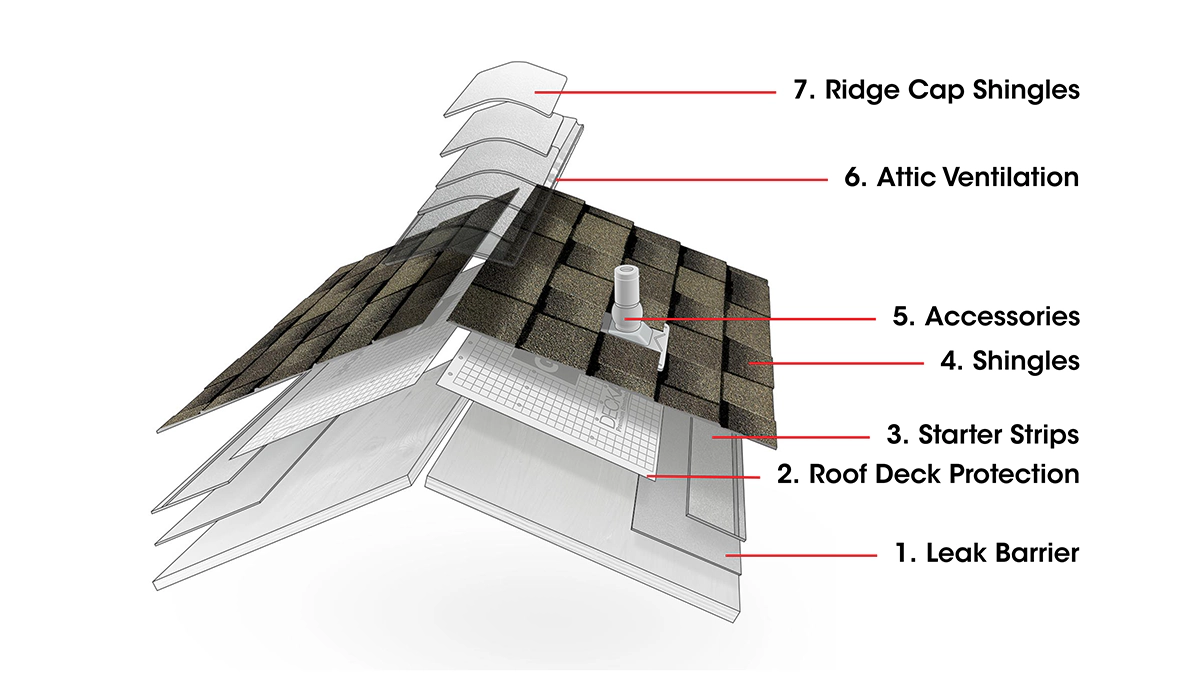
Let us go through a roof in the order it gets built, from the wood up:
Decking (also called Sheathing)
The plywood or OSB panels nailed to your rafters. This is the structural surface everything else attaches to. Most Delmarva homes have 1/2 inch or 5/8 inch plywood decking. When a roofer says “we found rotted decking and need to replace 6 sheets,” they mean 6 of these panels are too soft to hold a new roofing system.
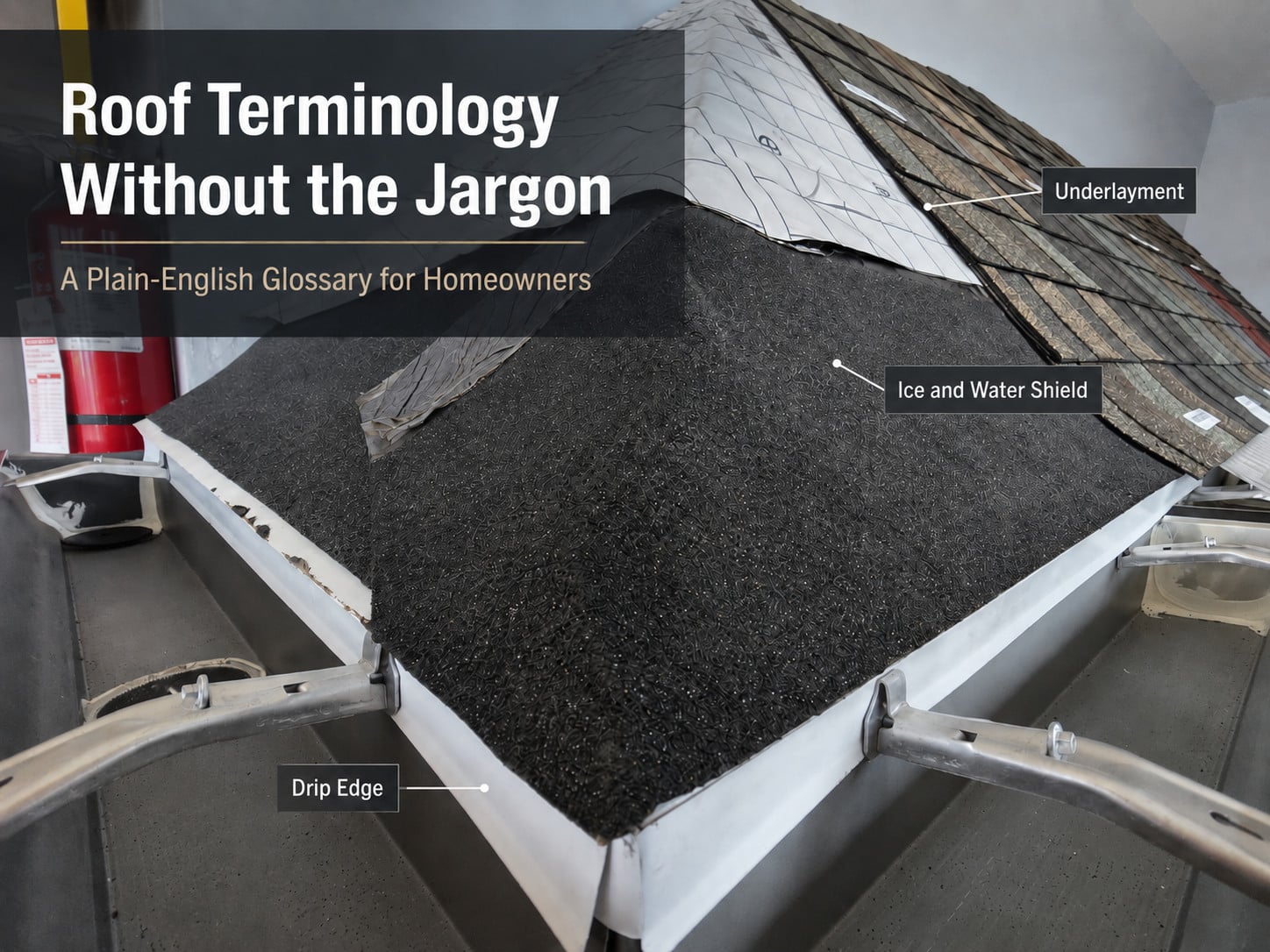
Underlayment
A water-resistant layer that goes between the deck and the shingles. It used to be 15-pound asphalt felt. Modern jobs use synthetic underlayment which is lighter, more tear-resistant, and lasts much longer. If your roofer quotes “15-pound felt” instead of “synthetic underlayment,” you are getting an outdated spec.
Ice and Water Shield
A self-adhering rubberized membrane that goes in the most leak-prone areas of the roof: along the eaves, in valleys, and around penetrations like chimneys and skylights. It self-seals around nail penetrations and provides a second line of defense against wind-driven rain. On Delmarva, ice and water shield should be standard in valleys and at every penetration, no exceptions.
Drip Edge
A metal strip installed along the eaves and rakes of the roof. It directs water away from the fascia and into the gutter. Cheap installs sometimes skip drip edge entirely. Do not let that happen on your home.
Starter Strip
The first row of shingles installed along the eaves, designed to seal down to the deck and provide a watertight starting point. Sometimes installed using upside-down regular shingles; sometimes a purpose-made starter product. Better-quality installs use a manufacturer-made starter strip.
Field Shingles
The main rows of shingles covering most of the roof. The standard residential product is “architectural” or “dimensional” shingles. Older budget homes use “3-tab” shingles which have a flatter appearance and shorter lifespan.
Ridge Cap
Specialized shingles that go along the very top ridge of the roof, where two slopes meet. They protect that exposed peak from water and wind. Better installs use a purpose-made ridge cap product matched to the field shingles.
Flashing
Metal pieces installed wherever the roof meets something else (a wall, a chimney, a skylight, a plumbing vent) to direct water away from the joint. Several types worth knowing:
- Step flashing: small L-shaped metal pieces woven into the shingle courses where the roof meets a wall.
- Counter-flashing: the upper piece that overlaps step flashing, often embedded into masonry on chimneys.
- Kick-out flashing: a small piece at the bottom of a wall-roof intersection that directs water out and into the gutter rather than behind the siding. Frequently missed by sloppy installers.
- Pipe boot or vent boot: a flexible rubber sleeve that seals around plumbing vent pipes coming through the roof.
Soffit and Fascia
Not technically roofing but always involved in roof work. The fascia is the vertical board at the edge of the roof that the gutter attaches to. The soffit is the horizontal underside between the fascia and the wall. Both are common sources of rot if a roof leaks.
Attic Ventilation
Intake (usually soffit vents) and exhaust (usually ridge vents) that let air flow through the attic. Critical for roof longevity. A roof without proper attic ventilation ages dramatically faster, especially in humid Delmarva summers.
Common Terms on Estimates and Quotes
Square
The unit of measurement for roofing. 1 square = 100 square feet. A 2,500 sq ft roof = 25 squares. You will see this in pricing.
Tear-Off
Stripping the old roof completely off down to the deck, as opposed to laying new shingles over the old (overlay or re-roof). Tear-off is almost always the right call on Delmarva because it lets the roofer inspect and replace any rotted decking.
Pitch (or Slope)
How steep your roof is, measured as inches of rise per 12 inches of run (e.g., “6/12 pitch” means 6 inches of rise for every 12 inches horizontal). Steeper pitches cost more to roof because of the safety setup required.
Penetrations
Anything that pokes through the roof: vent pipes, skylights, chimneys, satellite dish mounts. More penetrations equals more flashing detail equals more labor.
Frequently Asked Questions
Do I really need ice and water shield in Maryland and Delaware?
Yes, in valleys and around penetrations at minimum. Some installers add it along the entire eaves edge for extra leak protection. The cost is modest and the protection is significant on Delmarva where wind-driven rain is a real factor.
What is the difference between architectural shingles and 3-tab?
Architectural (or dimensional) shingles have a layered look that mimics wood shake or slate, last 25 to 30 years, and resist wind better. 3-tab shingles are flat, last 15 to 20 years, and are mostly used on rentals and budget projects today.
What does “1 square” mean in roofing?
1 square equals 100 square feet of roof surface. It is the standard measurement unit roofers use for pricing materials and labor. A 25-square roof is 2,500 square feet.
Check Your Estimate Against This
| Component | How it should read on your estimate | Red flag |
|---|---|---|
| Underlayment | Synthetic underlayment, brand named | “15-pound felt”, an outdated spec |
| Ice and water shield | Listed for valleys and every penetration | Not listed at all |
| Drip edge | Eaves and rakes | Omitted entirely |
| Starter strip | A manufacturer-made starter product | Upside-down field shingles |
| Ridge cap | Purpose-made cap matched to the field shingles | Cut-up field shingles |
| Field shingles | Named manufacturer and product line | “30-year shingle” with no brand |
| Decking | A per-sheet price for replacing rotted sheets | No allowance mentioned anywhere |
Every line in the middle column should be findable on a quote you are seriously considering. Anything in the right column is worth a direct question before you sign.
Reading Your Estimate With Confidence
Now that you know what all the words mean, you can read any roofing estimate and know what you are actually buying. If a quote skips key components or uses vague terms like “30-year shingle” without naming the manufacturer, that is a red flag.
Got questions about a quote you received? G and Bros is happy to walk through it with you, even if you are not hiring us. Call us at 410-677-4975 or visit gandbrosroofing.com/contact. We serve homeowners across Salisbury, Ocean City, and the entire Eastern Shore.

Recent Blog Posts