Signs of Poor Roof Ventilation in Salisbury, MD (and What to Do About It)

Roof ventilation is one of those topics most homeowners never think about until something goes wrong. Yet the airflow system under your shingles plays a bigger role in how long your roof lasts than almost any other factor. For homeowners in Salisbury, MD and across Wicomico County, the Eastern Shore climate makes proper ventilation especially important.
This guide covers how to spot the signs of poor attic airflow, what causes it, and what a balanced ventilation system should look like, so you can protect your home before small problems become expensive ones.
Why Roof Ventilation Matters More on Maryland’s Eastern Shore
Maryland’s Eastern Shore sits within the Chesapeake Bay watershed, which means humidity levels here run consistently higher than inland parts of the state. Summer afternoons in Salisbury regularly combine temperatures above 90 degrees with humidity that pushes the felt temperature even higher. That warm, moist air finds its way into every home, including the attic space above your roof deck.
Without a path to exit, that heat and moisture accumulates. In summer, attic temperatures can exceed 150 degrees Fahrenheit in a poorly ventilated space. In winter, temperature swings across the Delmarva Peninsula cause condensation to form on cold surfaces inside the attic. Both conditions put serious stress on your roof deck, insulation, and shingles over time.
The nor’easters and tropical storms that track up the Eastern Shore add another layer of risk: wind-driven rain can infiltrate soffit vents that are not properly designed for coastal exposure. Getting ventilation right matters here more than in many other parts of the country.
5 Warning Signs Your Roof Is Not Breathing Right
1. Unusually High Summer Cooling Bills
When an attic has no way to exhaust hot air, that heat radiates down into your living space and forces your air conditioning to work harder. If your cooling costs seem high relative to your home’s size, poor attic ventilation is worth investigating before assuming the issue is your HVAC system.
2. Ice Dams Along the Eave in Winter
Ice dams form at the edge of a roof when heat escaping through a poorly ventilated attic melts snow on the upper portion. That meltwater runs down and refreezes at the colder eave line, creating a dam that forces water back under the shingles. Ice dams are a recognized problem across the mid-Atlantic region, and poor ventilation is one of the leading causes.
3. Shingles Aging Faster Than Expected
Asphalt shingles carry specific lifespan ratings, but excessive heat from below can cause them to deteriorate years ahead of schedule. If your shingles are cupping, cracking, or losing granules before they should be, trapped heat in the attic may be a factor. A roof inspection can help determine whether ventilation is contributing to premature wear.
4. Mold, Mildew, or Moisture Stains in the Attic
Moisture-laden air that has no exit route will eventually condense on cold attic surfaces. Rafters, sheathing, and insulation are all vulnerable. Black staining on wood, a musty smell when you open the attic hatch, or damp-looking insulation are signs that moisture is building up where it should not be. Left untreated, this leads to rot and structural damage that goes far beyond the roof itself.
5. Blocked or Missing Soffit Vents
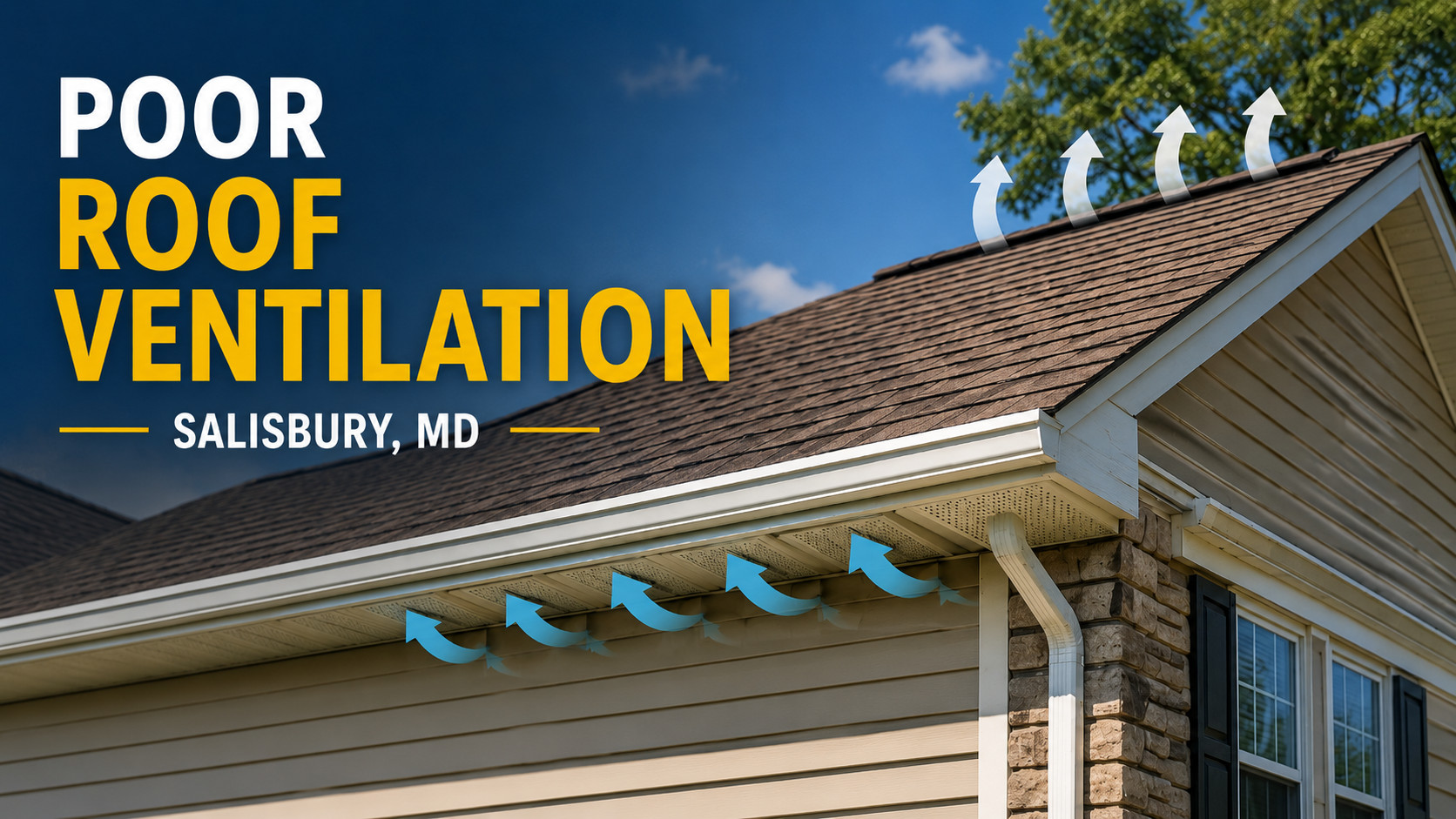
Proper ventilation requires air to enter through the soffits at the lower edge of the roof and exit through ridge vents or gable vents at the peak. If insulation has been pushed too close to the attic floor edge, or if soffit vents were never installed, the intake side of the system is starved. No amount of ridge venting can compensate for blocked intake. This is one of the most common oversights in older Eastern Shore homes across Wicomico County.
What a Balanced Ventilation System Looks Like
The goal of roof ventilation is a continuous flow of air from soffit to ridge. Air enters through perforated soffit panels or individual round vents along the underside of the eave, travels up through the attic space, and exits through a ridge vent running along the peak. This passive system requires no moving parts and works year-round without maintenance.
The key word is balanced. Building codes typically call for one square foot of net free ventilation area for every 150 square feet of attic floor space, split evenly between intake and exhaust. A home with more exhaust than intake draws air in through unintended gaps, which can carry moisture. A home with more intake than exhaust will not move air efficiently enough to matter.
Gable vents, powered attic fans, and turbine vents each work in certain configurations but can disrupt balanced flow if added without accounting for the existing system. A roofing professional can assess your specific attic geometry before recommending any additions.
G and Bros serves Salisbury, Fruitland, and communities across Wicomico County with inspections that include a full ventilation assessment. Call 410-677-4975 to schedule.
Frequently Asked Questions About Roof Ventilation
How do I know if my attic has enough ventilation?
A simple starting check is to enter your attic on a sunny afternoon. Extreme heat, moisture staining, a musty smell, or visibly blocked soffit vents are all warning signs. A licensed roofing contractor can measure your net free ventilation area and compare it against code requirements for your attic size.
Can I add ridge vents without replacing my entire roof?
In most cases, yes. A roofer can cut a slot in the ridge and install a continuous ridge vent without a full replacement. That said, if existing shingles are near the end of their lifespan, it often makes more sense to address ventilation during a roof replacement so everything is handled at once and no new shingles are disturbed.
Does poor ventilation void my shingle warranty?
It can. Most major shingle manufacturers specify minimum ventilation requirements in their warranty terms. If an inspector determines that inadequate airflow caused premature failure, a warranty claim may be denied. This is one reason to have ventilation reviewed both during installation and any time a problem is suspected.
Are powered attic fans a good solution for Eastern Shore homes?
Powered fans can help in specific situations, but they can also depressurize the attic and pull conditioned air from the living space below if intake venting is insufficient. For most Salisbury-area homes with standard attic configurations, a well-designed passive system with continuous soffit and ridge venting is the most reliable and cost-effective long-term approach.
How does Chesapeake Bay humidity affect my roof ventilation needs?
Higher ambient humidity means more moisture-laden air is available to infiltrate your attic. This raises the stakes for any ventilation shortfall because the moisture load is greater than in drier climates. Eastern Shore homes generally benefit most from ensuring intake venting stays fully open and that attic insulation does not block the airflow path along the eave line.
Ready to Schedule a Roof Inspection in Salisbury, MD?
Ventilation problems rarely announce themselves until damage is already underway. The best way to know where your roof stands is a professional inspection from a contractor who understands the specific conditions of Eastern Shore Maryland.
G and Bros is a family-owned roofing company based at 109 Clark Street in Salisbury, MD, serving Wicomico County and the surrounding Eastern Shore communities. Call us at 410-677-4975 or email office@gandbros.com to schedule your roof inspection today.

Recent Blog Posts