Running a Roofing Crew Without Losing Track of Change Orders
If you have run more than a few roofs, you know how it goes. Tear-off starts, the crew lead calls in, and the decking is worse than anyone could see from the ground. Six sheets need to come out. You tell him to go ahead, and the homeowner nods from the driveway. Two weeks later the invoice goes out, and she says she never agreed to pay $390 extra for decking.
That is not a communication problem. It is a process problem, and it costs roofing companies real money every year in unbilled work, disputed invoices and conversations that end with a bad review.
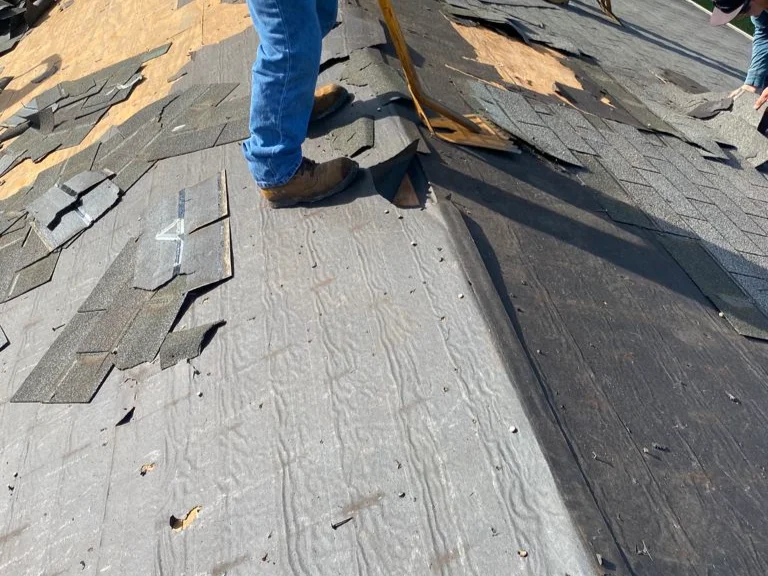
Tear-off on a G and Bros job in Quantico, MD. This is the moment most change orders start.
Where Roofing Change Orders Get Lost
Change orders rarely disappear at one point. They slip through several gaps at once:
- The agreement is verbal, between the crew lead and the homeowner in the driveway. Nobody writes it down before the work starts.
- The crew lead texts the office a photo of rotted sheathing with “adding 3 sheets.” Someone reads it and forgets to bill it.
- It gets written on the back of a delivery receipt that never makes it back to the office.
- It makes it onto the invoice, but the price quoted on the roof and the price billed do not match, and nobody can explain the difference.
- On an insurance job, a supplement item comes up during the install and is only discussed out loud. The adjuster pays the original estimate and nothing more.
Any one of these loses money. All five on the same job happens more often than it should, whether the job is a full roof replacement or a targeted repair.
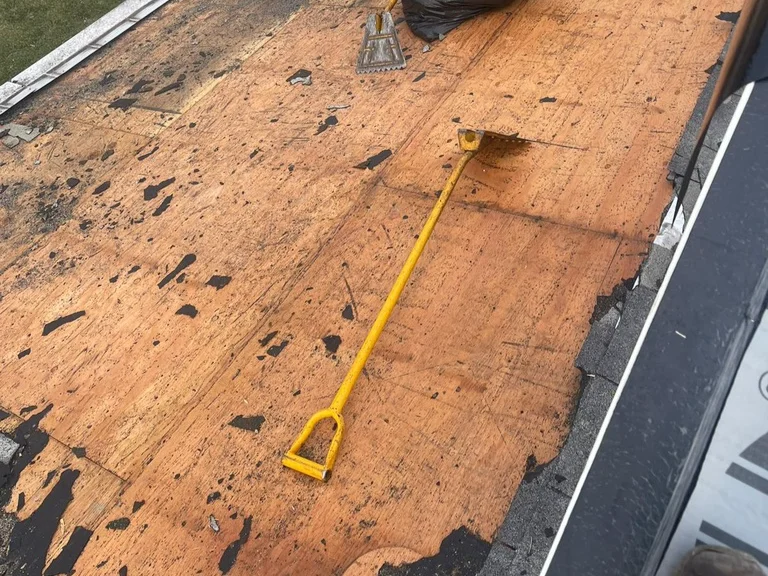
Decking exposed at tear-off on a G and Bros job in Nanticoke, MD. Photograph it before anyone touches it.
The Change Order Process We Use
A change order process does not need to be complicated. It needs three things: written customer approval, a price attached before the work starts and a record that stays with the job. Here is the sequence G and Bros follows on every job:
Every change, in this order
Photograph it first. The crew lead documents the condition before touching it: extra decking, rotted fascia behind the drip edge, a buried valley. Wide shot, then close-up.
Call the office before the extra work. Not after. This is the hardest habit to build and the most important one to enforce.
Write the change order with a price. The office builds a written change order with line items and sends it to the customer by text or email.
Get it signed before work starts. A signed change order, or a written reply that includes the price you quoted. A nod from the driveway does not count.
Keep it in the job file and tell the crew. The signed change order goes into the job record right away, and the crew knows it is approved before they cut a single sheet.
Step five is where most small crews fall apart. Steps one through four happen, then the approval sits in someone’s inbox until billing week. By then you are billing from memory instead of from documentation.
How a CRM Closes the Gap Between Field and Office
G and Bros is a family-owned roofing company in Salisbury, MD, in business since 2012. Our founder, Guillermo Molina Reyes, brings 25+ years of Maryland roofing experience. We run our change orders through JobNimbus.
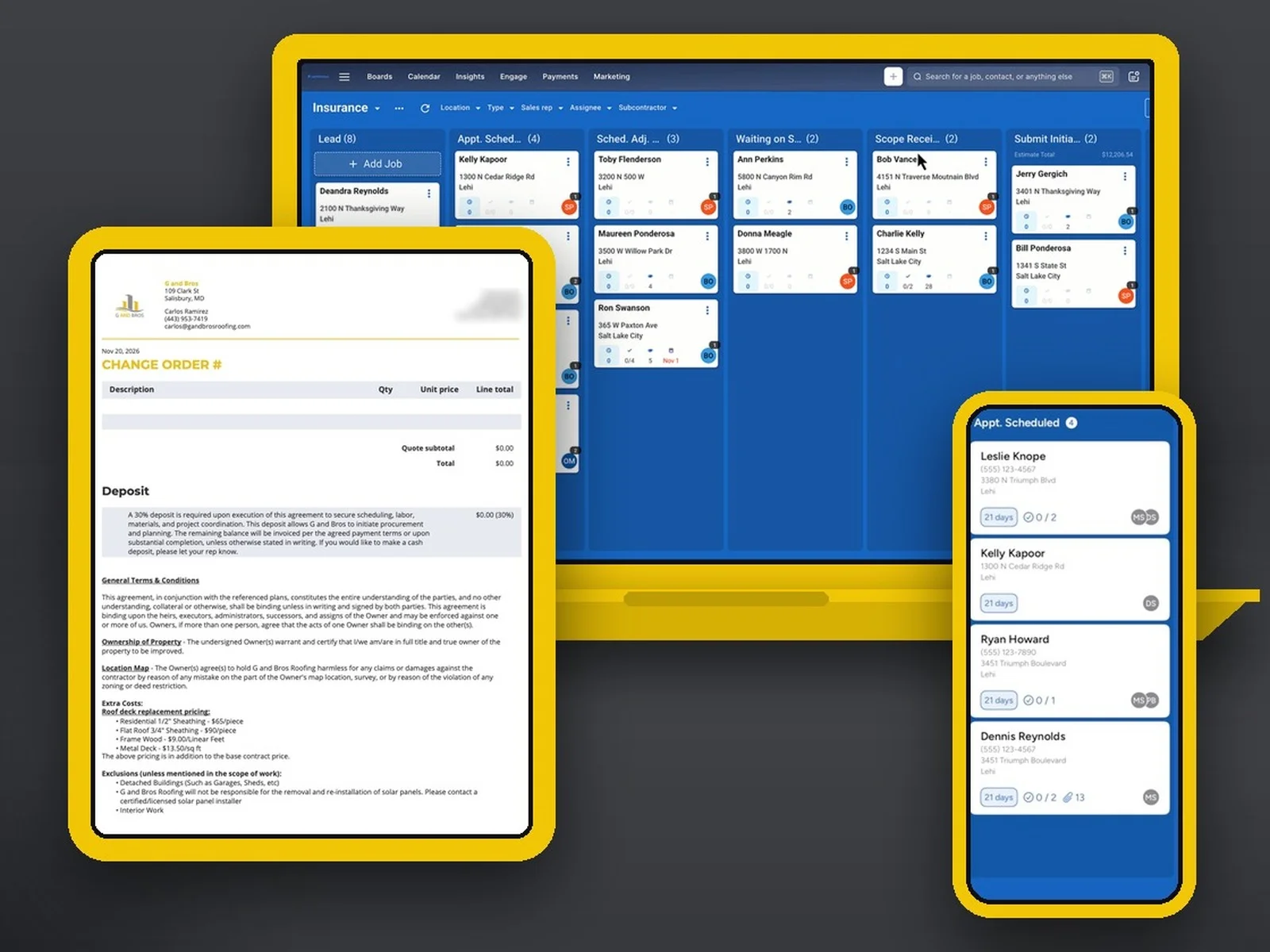
Our change order template, with the customer details blurred, next to JobNimbus boards on desktop and mobile. The boards show JobNimbus demo data.
When we create a change order in JobNimbus, it lives in the job record alongside the original contract, the photos and the material order. It is not stuck in a separate email thread or a text message.
The part that matters most to us: change orders are shared with the crew automatically. When the customer signs, the crew gets a notification and can open the signed change order in their JobNimbus app. Nobody on the roof has to guess whether the extra work was approved, and nobody in the office has to remember to pass it along.
On insurance work, the record does even more. When you go back to an adjuster with a supplement, you are showing a time-stamped photo of the condition, a change order signed by the homeowner and line items that match what you are asking for. That is much stronger than a text thread and a memory.
Is JobNimbus right for every roofing company? Probably not. If you run a handful of jobs a year, the learning curve may not pay off. If you have two or more crews working at the same time and you have lost a change order in the past year, it is worth a real look.
Disclosure: G and Bros uses JobNimbus for our own project management. The JobNimbus link above is a referral link, and G and Bros may receive a credit if you sign up through it. We recommend it because we use it every day.
Build the Habit Before You Add the Tool
Software only works if the habit is already there. If your crew lead calls in after the extra work is done, the platform does not matter. The homeowner has already watched work happen without approval, and now you are asking them to pay for it.
The habit is simple: no extra work starts without a written price attached to it first. That is a culture decision, not a software decision. It takes a direct conversation with every crew lead and steady follow-through when someone skips it.
When we started enforcing this at G and Bros, there was pushback. A crew lead does not want to stop a job and wait for a homeowner to sign something. Our answer: five minutes to get written approval is cheaper than two weeks of arguing over whether the homeowner agreed to nine sheets of decking. Most crew leads come around the first time their documentation works in their favor on a callback.
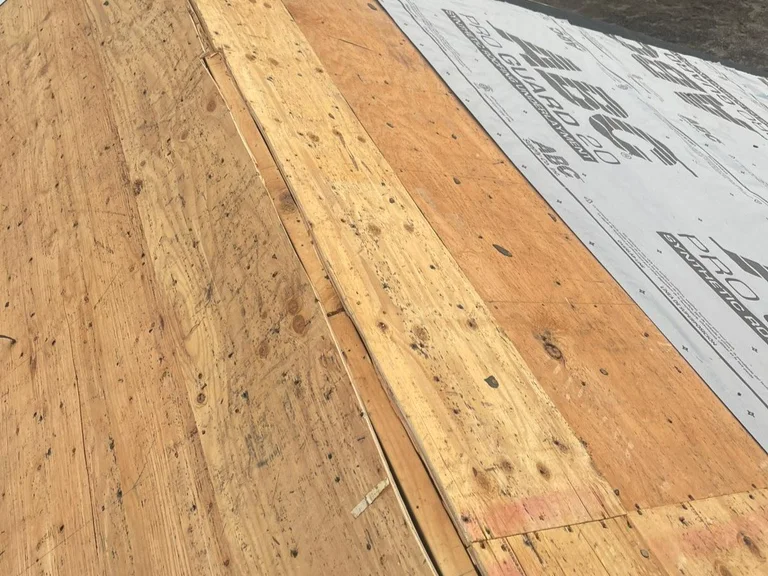
New sheathing going in on a G and Bros job in Nanticoke, MD. Every added sheet should trace back to a signed change order.
What Every Roofing Change Order Should Include
A change order that holds up in a dispute, or supports a supplement, needs these every time:
- Job address and original contract date
- A plain-language description of the added work
- Quantity and unit price. For example, our decking prices are $65 per sheet of 1/2″ sheathing and $95 per sheet of 3/4″ sheathing, on top of the base contract.
- Total price for the change
- A photo of the condition that triggered the change
- Homeowner printed name, signature and date
- Your company representative’s name and date
Do the math on the roof, not at billing: six sheets of 1/2″ sheathing at $65 each is $390. Put that number on the change order before the first sheet comes off.
That last field on the list matters. When a homeowner calls months later saying they never knew about the charge, you can name the person who was on site and show when the approval came in.
Frequently Asked Questions
What if the homeowner refuses to sign a change order?
Stop the extra work. Finishing work without written approval and then billing for it is a recipe for a dispute. Either complete only the original scope, or explain in writing why the added work is needed to do the job right. If the homeowner still declines, write that down and keep it in the job file.
How do you handle change orders when the homeowner is not home?
Send the change order by text or email with the price. Get a written reply that references the amount, or better, a signed change order. A written yes to a specific price is far easier to stand behind than a phone call.
Can a crew lead start a change order from the field without billing access?
Yes. The crew lead adds photos and notes to the job from their phone. The office turns that into a priced change order and sends it to the customer. Keeping pricing in the office and documentation in the field prevents pricing mistakes.
What about insurance supplements?
A supplement is a change order aimed at the insurance carrier instead of the homeowner. It needs clear photos, line items and an explanation of why the original estimate missed the item. G and Bros documents damage for homeowners but does not negotiate claims on their behalf.
How long should you keep roofing change orders?
At least as long as your workmanship warranty runs, and longer if you can. Digital records cost almost nothing to keep, and they are tied to the job when a warranty question comes up years later.
Need a roofer on the Eastern Shore?
G and Bros is GAF Certified Plus, family-owned since 2012, with 25+ years of Maryland roofing experience from our founder. If you landed here as a homeowner, we are a roofing company too. We handle roof replacements and repairs across Wicomico, Worcester and Sussex counties, and every change on your job is priced and signed before the work starts.
Get a Roof Quoteor call 410-677-4975

Recent Blog Posts