
Roofing CRM vs Spreadsheets: How to Tell When You Have Actually Outgrown the Spreadsheet
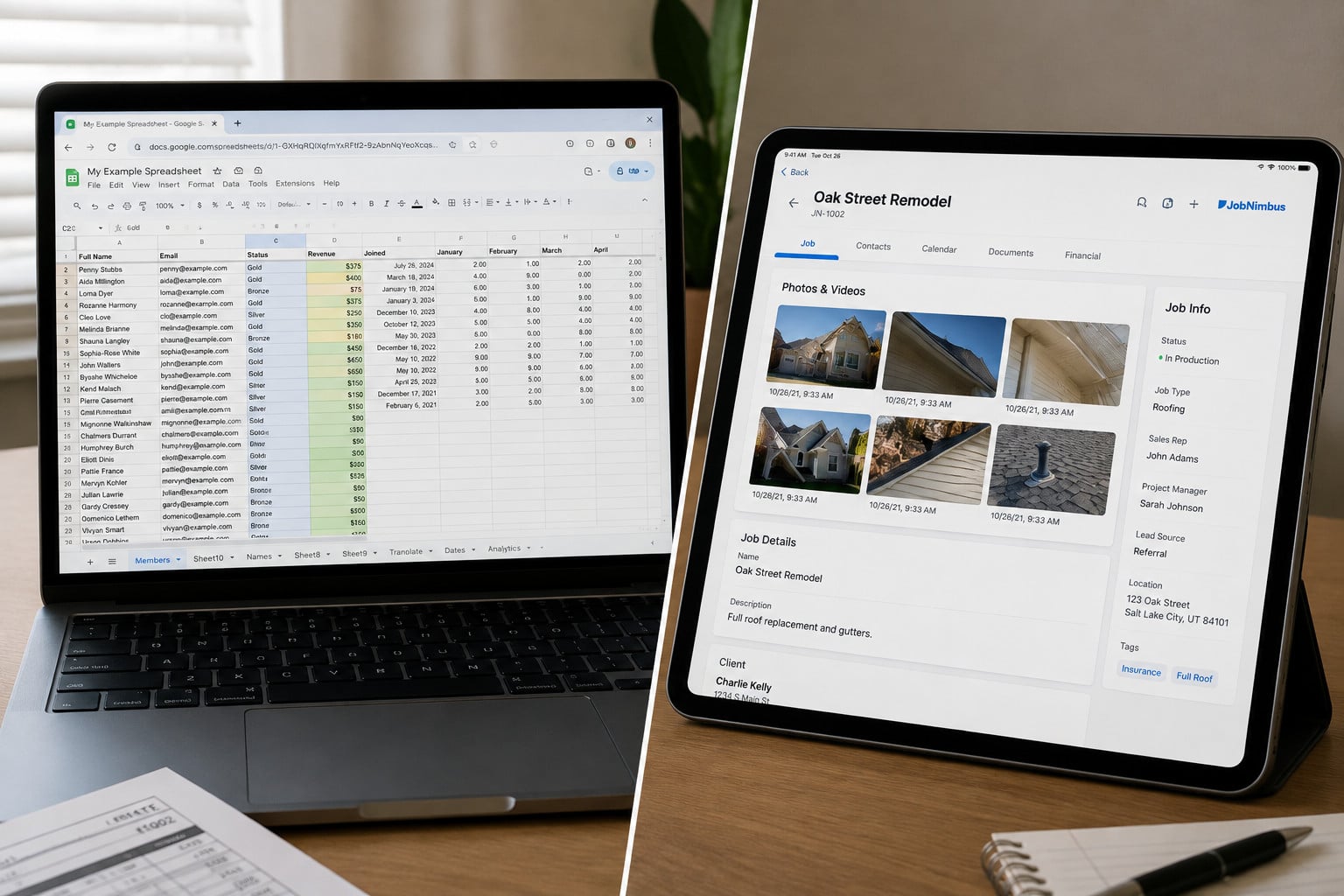
Almost every roofing company starts on a spreadsheet, and most of them run longer on it than the internet would have you believe. The spreadsheet is not the enemy. Plenty of profitable roofing companies are running one right now.
But there is a specific point where it stops being a tool and starts being a liability, and it is not the point most software companies tell you it is. Here is how to tell where you actually are.
The Spreadsheet Is Not the Problem. The Handoff Is.
A spreadsheet is good at holding data. It is bad at moving work between people.
Think about how many hands a single roof passes through. The estimator inspects and quotes. The office orders material and schedules. The crew lead runs the tear-off and finds bad decking. Somebody registers the warranty. Two years later somebody else fields the call about a leak.
That is five handoffs. A spreadsheet handles zero of them. Each one gets bridged by a phone call, a text, or somebody’s memory, and every bridge is a place a job falls through.
So the real question is not “how many jobs are you doing.” It is “how many people touch a job, and how are they finding out what happened before them.”
Five Signs You Have Actually Outgrown It
1. There is more than one version of the truth
Somebody has a local copy. There is a version in a text thread. The one on the shared drive is two days behind. When two people quote different numbers on the same job to the same customer, you are past the line.
2. Photos live on phones instead of on jobs
This is the expensive one. Inspection photos, decking photos, and completion photos sitting in three different camera rolls are not documentation. They are documentation you cannot find. The day you need them is the day an adjuster is asking, or a customer is disputing a change order, and “let me check with my guy” is the wrong answer.
3. You cannot answer “what happened on this job” without calling someone
Try it on a job from four months ago. If reconstructing it takes two phone calls, your job history lives in people’s heads, not in your system. That works until somebody quits.
4. Change orders get written from memory after the fact
A change order written three days later from recollection is how disputes start. If your process depends on a crew lead remembering to tell the office something, and the office remembering to write it down, you have a process that fails on any busy week.
5. Follow-up depends on somebody remembering
Estimates that never got a second touch are the most expensive line item in most roofing companies, and they never show up on a P and L. If you cannot pull a list of every quote sent in the last 30 days that has had no response, you are losing work you already paid to generate.
One or two of these is normal. Four or five and the spreadsheet is costing you more than software would.
What a Roofing CRM Actually Does
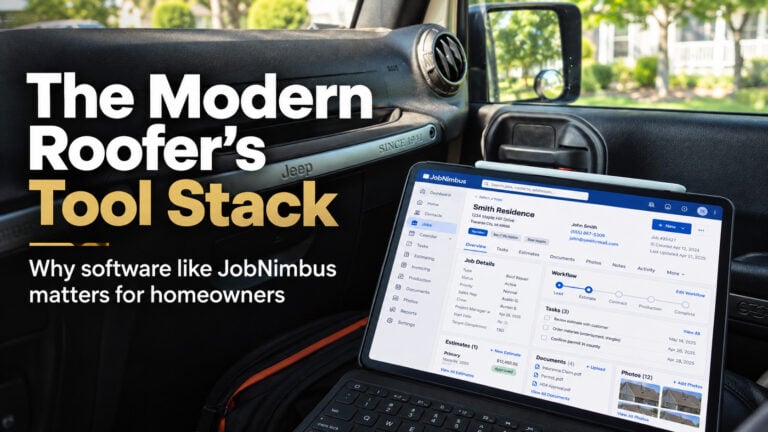
JobNimbus is the one built specifically for roofing and the one we run, so it is what we can speak to honestly. The category generally does four things a spreadsheet structurally cannot:
- The record attaches to a property, not a row. Photos, contracts, notes, and messages live on the job. There is one place to look.
- Field and office write to the same record. A crew lead uploads decking photos from the roof, and the office sees them without anyone sending anything.
- Status is a workflow, not a column somebody updates. Jobs move through defined stages, so nothing sits in limbo unnoticed.
- Follow-up gets triggered instead of remembered. Quotes with no response surface on their own.
Being straight about the limits, because it matters: a CRM will not fix a pricing problem, will not make a disorganized owner organized, and will not be adopted by a crew that was not brought into the decision. Software makes a good process faster. It makes a bad process fail more visibly, which is useful, but it is not the same as fixing it.
Pricing on these platforms is per user and changes, so check current rates directly rather than trusting a number in a blog post.
What Switching Actually Costs
The subscription is the smallest number in this decision. The real cost is two to four weeks of running both systems while people build the habit, and the productivity dip that comes with it. Budget for that or you will quit halfway and end up with two half-populated systems, which is worse than the spreadsheet.
The most common mistake is trying to migrate five years of history on day one. Do not. Old jobs stay in the spreadsheet as an archive. The new system starts with active jobs only.
The other thing people underestimate is crew buy-in. If your crew leads think this is surveillance, it will not stick. Frame it the way it actually works for them: fewer phone calls asking where they are, and a photo record that backs them up when a customer claims damage they did not cause.
A Realistic 30-Day Rollout
- Week 1: new jobs only. Every new lead goes in the system. Nothing else changes. Do not touch the archive.
- Week 2: photos and documents. Crews upload from the field. This is the habit that carries everything else, so make it the only thing you push this week.
- Week 3: templates. Build your estimate template and your change order template. Standardize them once instead of rewriting each time.
- Week 4: reporting. Now start pulling numbers: jobs by stage, quotes with no response, average days from signed to installed.
One change per week. Trying to do all four at once is the single most reliable way to fail this.
When the Spreadsheet Is Still the Right Call
Stay put if you are a solo operator doing mostly repairs, if you handle every job start to finish yourself, or if you are running a low enough volume that you can genuinely hold every open job in your head.
Buying software to look like a bigger company is a bad reason to buy software. The trigger is handoffs, not ego. When work regularly passes between two or more people, the math changes. Until then, it usually does not.
What We Run at G and Bros
We are a family-owned roofing company in Salisbury, Maryland, family-owned since 2012, with 25+ years of Maryland roofing experience from our founder. We ran spreadsheets longer than we should have, and the thing that finally forced the switch was not volume. It was a warranty call on a job old enough that nobody could remember the details, and it took most of a day to reconstruct something that should have taken thirty seconds.
We run JobNimbus for project management now, EagleView for measurements, and digital signing for contracts. Every job is documented end to end, and any customer can request their file at any point.
Disclosure: G and Bros uses JobNimbus for our own project management. The JobNimbus link above is a referral link. If you sign up through it, G and Bros may receive a credit. We recommend it because we actually use it, not because of the credit.
Frequently Asked Questions
How many jobs per year justifies a roofing CRM?
Volume is the wrong metric. Handoffs are the right one. A company doing 40 jobs a year with four people touching each one needs a system more than a solo operator doing 80 repairs alone.
Can I run one from the field?
Yes. Roofing-specific platforms are built mobile-first because most of the work happens away from a desk. If a tool cannot be fully operated from a phone on a roof, it was not built for this trade.
What happens to my old spreadsheet data?
Leave it. Archive the spreadsheet and start the new system with active jobs. Bulk-importing years of incomplete records mostly imports the mess.
Will my crew actually use it?
Only if the first thing you ask of them is easy and obviously useful. Start with photo upload. It takes seconds, it protects them in disputes, and it builds the habit that everything else rides on.
Is a general CRM good enough instead of a roofing-specific one?
It can work, but you will spend real time configuring things a roofing platform ships with: measurement integrations, supplement tracking, production stages that match how a roof actually gets built. Weigh setup time against subscription cost.
If You Are Weighing the Switch
Count your handoffs, then run the five signs above honestly. If you land on four or five, look at JobNimbus using the link earlier in this post. If you land on one or two, keep the spreadsheet and spend the money on something that will move the needle sooner.
If you landed here as a homeowner on the Eastern Shore, we are a roofing company too. Call G and Bros at 410-677-4975.

Recent Blog Posts